
For much of my 20 years working in SEO, the primary objective has been relatively consistent: helping businesses become more visible when potential customers search for their products or services.
The technology, techniques and competitive landscape have changed considerably, but that underlying objective remains. What is changing now is how businesses are discovered, evaluated and recommended.
On 24th November 2026, Google updated its Search Central documentation with a detailed explanation of how its generative AI search features select sources, establish factual accuracy and corroborate information.
For businesses investing in SEO, Answer Engine Optimisation (AEO), Generative Engine Optimisation (GEO) and digital PR, the documentation provides an important insight into the future of search. It also reinforces much of the thinking behind SEO 2.0 and our proprietary nine-step methodology at Woya Digital, The Woya Way.
SEO Is the Foundation of AI Search
One of the most significant points in Google’s latest documentation is its confirmation that its customised Gemini model is:
“integrated directly with Google’s core web ranking, information retrieval, and quality systems”
Google Search Central: Attribution and factuality in Search generative AI features
This directly challenges the suggestion that AI optimisation is replacing traditional SEO. Google’s AI Overviews and AI Mode draw upon information retrieved through its established search infrastructure. The systems that help Google discover, understand and evaluate web content therefore remain fundamental to its generative search experiences.
Technical SEO, website architecture, indexing, content quality, relevance and authority have not suddenly become less important. They provide the foundations upon which additional AI search opportunities can be built.
At Woya, this is precisely why we do not position GEO as a replacement for SEO. We see it as an extension of a broader, joined-up search strategy.
How Does Google Select Sources for AI Search?
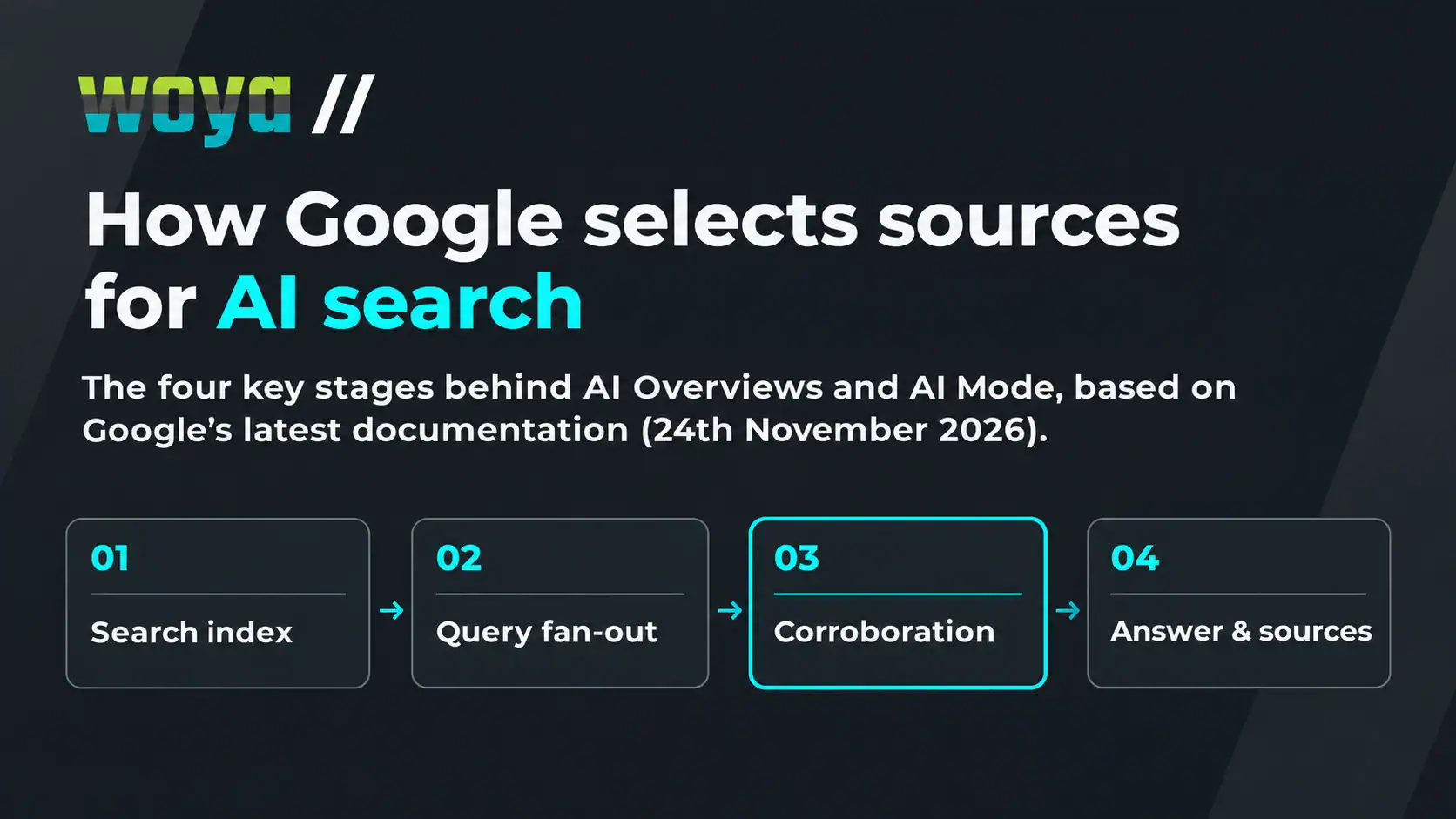
The following four-stage illustration summarises how information is retrieved, synthesised and presented within Google’s generative search experiences.
1. Retrieving Information From the Search Index
Google retrieves relevant information from its established search index, providing the AI model with material upon which to construct its response. This reinforces the importance of ensuring that your website is technically accessible, correctly indexed and contains relevant, useful information. If your content is not eligible to appear in Google Search, it cannot appear as a supporting link in Google’s generative search features.
2. Query Fan-Out
Rather than relying exclusively on the original search question, Google may undertake multiple related searches to explore different aspects of the user’s requirements. This process is known as query fan-out.
Imagine someone searching for: Which home care providers in West Sussex offer specialist dementia care, flexible visiting hours and excellent customer reviews?
| Potential related search | Information being sought |
|---|---|
| Home care providers in West Sussex | Geographic relevance |
| Specialist dementia home care | Service expertise |
| Flexible visiting care services | Service availability |
| Home care provider reviews | Customer experiences |
| Home care provider CQC ratings | Regulatory information |
| Local home care news and coverage | Additional business context |
Illustrative example of query fan-out, not an actual Google search trace.
A business may therefore have opportunities to become visible through several aspects of a customer’s question, rather than solely through a single target keyword. This is one reason why SEO strategies need to consider broader search intent, customer questions and the overall information surrounding a business.
3. Grounding and Corroboration
Grounding is the process of using retrieved information to support a generated response. Corroboration involves establishing whether the information presented is supported by relevant sources. Google describes checking information against reliable web content and other information sources, including its Knowledge Graph and relevant data feeds.
For me, this is one of the most commercially significant elements of the documentation. It raises an important question for businesses:
How much reliable information exists about your organisation beyond your own website?
4. Displaying the Answer and Supporting Sources
Google determines how to present the generated response and which supporting sources to display. Relevance, quality, source diversity and the user experience influence how those links are presented.
For businesses, visibility is no longer solely about securing a position within a traditional list of search results. It may also involve becoming a supporting source within an AI-generated answer.
Why Corroboration Changes the Role of Digital PR
Historically, much of the conversation around off-page SEO has focused on backlinks. How many referring domains does a website have? What is its Domain Authority or Domain Rating? How much ranking value might a particular link contribute?
These metrics can still provide useful context, but they do not represent the entirety of a business’s online reputation or visibility. In the AI search era, the information contained within external publications is becoming increasingly interesting.
A company website can explain what a business does, its experience, its areas of expertise and why potential customers should choose it. However, the organisation itself is the source of those claims. Relevant information published elsewhere can provide additional context, supporting evidence and opportunities for discovery.
| Information source | Potential contribution to AI discovery |
|---|---|
| Company website | Services, expertise and business information |
| Industry publications | Specialist knowledge and professional commentary |
| News publications | Business developments and achievements |
| Award organisations | Recognition and accomplishments |
| Customer review platforms | Customer experiences and feedback |
| Professional associations | Memberships and credentials |
| Regulatory bodies | Verified professional or organisational information |
| Local publications | Community presence and geographic relevance |
This is where strategically planned digital PR can play an increasingly important role. Rather than simply acquiring links, businesses should be considering how to build an accurate, consistent and credible body of information that exists across the wider web.
What does your business specialise in? Who are its experts? What has it achieved? Where does it operate? What differentiates it from its competitors? And importantly, where else can that information be found?
From Backlinks to a Wider Evidence Base
I have seen numerous changes in link-building strategies over the past two decades. An industry that once placed considerable emphasis on the quantity of backlinks gradually moved towards relevance, quality and authority. AI search introduces another dimension: the potential usefulness of the information contained within those external references.
| Traditional link-building focus | Digital PR in the AI search era |
|---|---|
| Acquiring backlinks | Building a discoverable brand presence |
| Domain authority metrics | Source quality and credibility |
| Anchor text | Contextual relevance |
| Link equity | Supporting information |
| Keyword rankings | Wider search and AI visibility |
| Referring domain counts | Relevant external references |
| Website authority | Brand expertise and reputation |
These approaches are not mutually exclusive. Rather, digital PR broadens the objectives of traditional off-page search marketing.
A relevant publication containing meaningful information about a business may have discovery value even when its link is nofollow, or when there is no hyperlink at all. That does not mean Google has confirmed unlinked brand mentions as a direct ranking factor. Nor does it mean that publishing a press release automatically improves AI visibility.
Paid publication must also comply with Google’s spam policies, including the appropriate qualification of paid links. The objective should be to communicate genuine, useful information about a business, rather than attempt to manipulate search or AI recommendations.
Not All Digital PR Is Equal
Publishing the same information across numerous websites should not necessarily be confused with generating high quality mentions and endorsements.
At Woya, we believe effective digital PR should form part of a wider search strategy, with publication activity aligned to the services, expertise, markets and commercial priorities of the business.
A specialist healthcare organisation, for example, might benefit from publishing expert commentary, research, service developments and news about its clinical team. A financial services business might focus on market insights, professional expertise and relevant regulatory developments. A local service provider might benefit from communicating genuine community involvement, business milestones and developments within its service areas.
The common objective is to build a more discoverable and informative digital presence, supported by genuine business activity and expertise. This is also the thinking behind our specialist digital PR publication capability through Fleet Street News.
Why We Developed SEO 2.0 and The Woya Way
After 20 years in search marketing and experience across more than 1,000 campaigns, I have seen how easily businesses can become distracted by individual marketing tactics rather than their overall commercial objectives. The emergence of generative AI has accelerated that challenge.
Businesses are now being offered SEO, AEO, GEO, digital PR and AI visibility services, frequently as separate solutions. But these disciplines are increasingly interconnected. That is why we rebuilt Woya Digital around SEO 2.0, delivered through our proprietary nine-step methodology, The Woya Way.

Figure 2. SEO 2.0 connects SEO, AEO, GEO and Local SEO with digital PR and authority building.
Our approach connects four core search disciplines, supported by strategic authority building and digital PR.
| Discipline | Its role within SEO 2.0 |
|---|---|
| SEO | Establishes technical, content and authority foundations for search visibility. |
| AEO | Develops clear, useful answers to the questions potential customers ask. |
| GEO | Strengthens information, entity signals and wider evidence surrounding a business to support AI discovery. |
| Local SEO | Develops geographic relevance through local content, business profiles, reviews and consistent business information. |
| Digital PR | Supports authority and discoverability beyond the organisation’s own website. |
The Woya Way connects research, technical improvements, onsite optimisation, content, local discovery, authority building, reporting and conversion activity through a structured delivery process.
Rather than treating each element as an isolated project, we consider how they collectively contribute to making a business easier to find, understand, trust and choose. The methodology remains consistent, while the depth and focus of delivery are adapted to the business, its competitive landscape and its commercial objectives. Google’s latest documentation reinforces the importance of this joined-up approach.
The Customer Journey Is Already Changing
In October 2026, we experienced a significant milestone at Woya. We held our first prospective client meeting booked through AI. The prospective client had not visited our website before the meeting.
For a business that has spent years helping clients increase search visibility and generate website enquiries, that was a particularly interesting moment. It demonstrated how the relationship between discovery, research and conversion is evolving.
A potential customer can increasingly discover a business, assess its credentials, compare alternatives and take action through an AI-assisted experience. The website remains important, but it may no longer be the first point of contact between a business and its potential customers.
That means visibility cannot be assessed solely through keyword rankings, website traffic or traditional organic search journeys. Businesses also need to understand whether they are being mentioned, referenced, accurately represented and recommended within relevant AI search experiences.
What Should Businesses Be Doing Now?
The first step is not necessarily to invest in more content, more backlinks or a standalone AI optimisation campaign. It is to evaluate the strength and consistency of the foundations already in place.
| Strategic priority | Question to ask |
|---|---|
| Technical SEO | Can search engines effectively access and index our important content? |
| Content and AEO | Are we providing clear, useful answers to real customer questions? |
| Brand information | Is our business accurately and consistently represented online? |
| Digital PR | Does relevant information about our expertise exist beyond our website? |
| Local visibility | Are our locations, reviews and business profiles accurate and current? |
| AI visibility | Are we appearing in relevant AI-generated answers and recommendations? |
| Commercial performance | Is our visibility translating into meaningful business opportunities? |
Google’s wider guidance on optimising websites for generative AI search also reinforces the importance of original, experience-led content and established SEO best practices.
Google: Optimising your website for generative AI features
There is no reason to abandon sound SEO principles in pursuit of the latest AI optimisation technique. Instead, businesses should build upon those foundations with a strategy that reflects how search behaviour and discovery are changing.
The Future of Search Is Connected
Google’s latest documentation does not reveal a secret formula for AI visibility. It does, however, provide further clarity on the relationship between established search systems, generative AI, factual accuracy and supporting information.
For businesses, the implications extend beyond Google rankings. Your website remains a fundamental part of your digital presence. But the wider information surrounding your organisation is also becoming increasingly important to how customers and AI search systems discover and evaluate your business.
- SEO is not being replaced.
- Digital PR is not simply becoming another form of link building.
- And AI optimisation should not be viewed as an isolated marketing activity.
- The future of search requires these disciplines to work together.
That is SEO 2.0 and that is The Woya Way.
Is your search strategy ready for the AI era?
At Woya Digital, we help businesses build visibility across Google, AI search and the wider customer discovery journey through our proprietary SEO 2.0 methodology.
Explore our search marketing services or explore our SEO packages.

“AI search is not a replacement for SEO. Google’s latest documentation reinforces why strong search foundations, clear expertise and credible third-party coverage need to work together. This is exactly the thinking behind SEO 2.0 and The Woya Way.”
