

Choosing a care home is a significant and often emotional decision. Before contacting a provider, families may look at its website, Google Business Profile, online reviews, care-directory listings and Care Quality Commission (CQC) information.
Genuine, recent care home online reviews matter because they provide insight into the experiences of residents and families. They can reduce uncertainty, strengthen a home’s wider local presence and help people decide whether to find out more. Reviews however, do not replace good care, accurate information or proper due diligence.
Why Do Online Reviews Matter When Families Choose a Care Home?
Families considering residential or nursing care are not simply comparing services or facilities.
They are trying to understand whether a home feels trustworthy, whether staff communicate well and whether their relative is likely to be treated with care, dignity and respect. A provider’s website can explain its services, values and approach, but independent feedback adds a different perspective. Reviews may refer to how a resident was welcomed, how staff kept relatives informed or how a concern was handled.
These details can help a family form a more rounded impression before arranging a visit. Consider two otherwise similar care homes in the same area. One profile contains several recent, detailed reviews and thoughtful responses from the provider. The other has only a few older comments that have not been acknowledged. This does not prove that the first home provides better care, but it does give families more current information and fewer unanswered questions.
Reviews should always be considered alongside the home’s website, CQC inspection report and rating, conversations with the provider and an in-person visit. Each serves a different purpose. Reviews reduce uncertainty; they do not replace due diligence.
Do Reviews Help Care Homes Appear in Local Search?
Reviews can contribute to local search visibility, but they are only one part of the picture. Google explains that local results are mainly based on relevance, distance and prominence. Its guidance also states that more reviews and positive ratings can help local ranking.
For a care home, this means a complete and accurate Google Business Profile, the appropriate business category, current contact details and clear information about the services provided all matter. The home’s website, local relevance and wider online prominence also contribute to how easily the organisation can be found and understood.
| Signal | What it helps communicate | Practical action |
|---|---|---|
| Accurate profile information | Relevance and confidence | Keep the name, address, phone number, care types and opening information current |
| Genuine reviews | Recent experiences and recurring themes | Invite honest feedback at appropriate moments |
| Professional responses | Responsiveness and willingness to listen | Reply without discussing confidential information |
| Website and location content | Service and local context | Maintain clear care-type and location information |
A business must verify its Google Business Profile before it can reply to reviews. Google says that helpful, positive replies can show customers that a business is responsive, while approved replies are publicly visible beneath the review.
Review activity should therefore form part of a wider care home SEO strategy, rather than being treated as a standalone route to greater visibility. Strong local performance also depends on the website, profile accuracy, relevant content and the overall experience provided to people who find the home online.
At Woya Digital, we partner exclusively with UK care homes, nursing homes and residential care providers, ensuring each online marketing strategy is tailored to the sector’s distinct needs. This includes understanding the importance of local visibility, family trust, private enquiries and sensitive, accurate communication.
What Role Can Reviews Play in AI-Led Discovery?
AI-led search is changing how people research services. Rather than presenting only a list of links, some search experiences combine information from websites, business profiles and third-party sources into a direct response. Reviews can add public language about a care home and the experiences associated with it.
Recurring references to communication, activities, food or the admissions process may provide additional context beyond the provider’s own description. Consistency also matters. Imagine a home that is accurately described as providing residential and dementia care in a particular town across its website, Google profile and relevant care directories.
This gives search and AI systems clearer information than a digital presence containing different addresses, outdated service descriptions or conflicting names. That does not mean reviews guarantee inclusion in AI-generated answers or recommendations. AI systems may omit information, misunderstand context or surface outdated details.
No review-management tactic can promise a particular result. The priority should be to build a clear, credible and consistent online presence for people first. This also gives search platforms more reliable information from which to understand the organisation.
Where Should Care Homes Collect and Manage Reviews?
Care homes should focus on the channels families genuinely use, rather than trying to gather feedback everywhere.
| Channel | What families find there | Provider action | Important distinction |
| Google Business Profile | Public reviews alongside local business information | Keep details current, invite genuine feedback and respond professionally | Reviews reflect individual experiences, not regulatory assessment |
| Care directories | Service information, comparison details and directory reviews | Maintain accurate care types, facilities, contact details and imagery | Check the directory’s review and verification policies |
| Care home website | Provider information, testimonials and first-party stories | Obtain permission and keep the context accurate | Do not present edited or selective testimonials misleadingly |
| CQC | Independent inspection reports and regulatory ratings | Link to current information and address inaccuracies through the correct route | CQC reports and ratings are not consumer reviews |
Surveys, thank-you messages and direct family feedback are also valuable, even when they are not published. They can highlight what the home is doing well and identify areas that need attention. Where testimonials are used on the website, the provider should have appropriate permission and protect the dignity and privacy of residents and families.
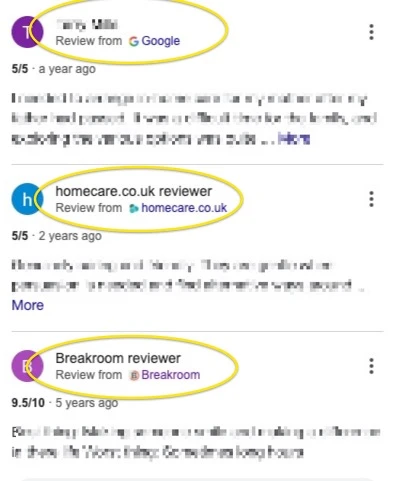
How Can a Care Home Request and Respond to Reviews Responsibly?
A good review process is designed to gather honest feedback, not manufacture a perfect rating.
Ask for Honest Feedback at an Appropriate Moment
Families can be invited to leave a review after genuine positive feedback, once a resident has settled or following a constructive care-plan discussion.
The request should be optional and should welcome an honest account rather than asking for five stars or prescribing what to write. Google allows verified businesses to create a direct review link or QR code, which can make the process simpler. However, convenience should never become pressure.
Avoid requesting a review during a crisis, while a complaint remains unresolved or at another emotionally insensitive time. Businesses should not buy, fabricate or commission false feedback. They should also be cautious about incentives. Government guidance on consumer reviews explains the responsibilities of organisations that publish review content, including the need to address fake reviews, concealed incentivised reviews and misleading review information.
Respond Without Compromising Privacy
Responses should be warm and professional, but they must not reveal personal or care-related information. Before publishing a reply, check:
- Does it protect the identity and privacy of residents and families?
- Is the tone calm, respectful and non-defensive?
- Does it avoid confirming diagnoses, incidents, medication or care-plan details?
- Does the concern require internal escalation through a complaints or safeguarding process?
- Does it offer an appropriate private route for further discussion?
A fictional example response to a negative review might read: We are sorry to read that you have concerns. We take all feedback seriously and would welcome the opportunity to understand the situation properly. Please contact the home manager directly so that this can be discussed privately and handled through the appropriate process.
The response does not confirm whether the reviewer or their relative used the service, argue about the account or disclose confidential details.
Learn From Recurring Themes
Review management should be treated as listening, not simply marketing. If several reviews mention communication delays, unclear updates or problems during admissions, this may indicate an operational issue that deserves attention.
Positive feedback is useful too. It can show which aspects of the resident and family experience are most valued and provide recognition for staff. Tracking themes over time helps a provider connect its public reputation with genuine service improvement.
A Practical Monthly Review Check for Care-Home Teams
A simple monthly process can keep review management consistent:
- Check new feedback across priority platforms.
- Respond using an approved, privacy-conscious process.
- Correct outdated business or care-service information.
- Record recurring themes and escalate material concerns.
- Identify suitable opportunities to invite honest feedback.
- Confirm that website testimonials remain permissioned and accurate.
- Compare the public profile with current website and CQC information.
Responsibility should sit with a named person, such as the registered manager, admissions lead or marketing contact. The purpose is not to chase a particular score but to ensure that public information is current, feedback is acknowledged, and important issues reach the right internal team.
Reviews Work Best as Part of the Wider Strategy
Genuine reviews can build family confidence, support local discovery and provide useful context across an increasingly varied search landscape. Their value comes from authenticity, relevance and responsible management, not volume alone.
Care homes should make honest feedback easy to share, respond with sensitivity and use recurring themes to inform improvement. Reviews should then be considered alongside accurate profiles, clear website content, CQC information and the quality of the enquiry journey.
If your care home’s online presence does not accurately reflect the service you provide, Woya can review the wider route from local discovery to website enquiry.
Our Healthcare Growth Catalyst is an integrated online visibility accelerator that combines specialist healthcare SEO, local search optimisation, content marketing, digital PR, PPC and AI search optimisation. It is designed to strengthen the signals that help care providers become more visible, better understood and easier for families to find online.
Explore the Healthcare Growth Catalyst, learn more about our specialist SEO support for care homes or arrange a local visibility review with Woya Digital.