Woya Digital’s SEO Marketing Success Strategy

Woya Digital’s SEO Marketing Success Strategy

Reading Time: 8 minutes

SEO marketing (search engine optimisation) should be a key focus for those looking to grow a competitive and advantageous online presence.

The lack of transparency in the search engine results sector however, does create confusion amongst those seeking support with search engine related services.

At Woya Digital, our expert SEO team have curated a structured, considered and balanced blueprint which guides us through all SEO campaigns. This blueprint is based on years of vast expertise, knowledge and experience.

The elements of SEO are constantly changing, meaning it is imperative that businesses choose not just a trusted partner for their SEO marketing, but also one that keeps up to date with the ongoing developments in the sector and is therefore able to maintain SEO growth and success.

Here we provide an overview of the main elements contained within SEO marketing, and just how we at Woya manage a strategy for SEO success.

Why is Search Engine Optimisation so important for modern businesses?

There are few businesses still in existence who don’t benefit from a digital presence – and while this can make brands, products and services easier to find for those seeking them, it also means that the online market place is pretty crowded.

Focussed SEO efforts allows for organisations to differentiate themselves and stand out from the crowd in their given sector or industry, gaining competitive advantage and converting online visitors into paying customers.

With more understanding than ever of search engine optimisation practices amongst marketers, but with a frequently updated marketplace in which to function (it’s estimated that search engines such as Google tweak their algorithms and programming more than once a week), it is critical that businesses invest in successful and strategic SEO marketing in order to maintain their presence in search results.

Organic SEO

A well understood SEO tactic is to buy advertisements and essentially ‘pay your way’ to a high search engine ranking, but this aspect of SEO does not prove genuine authenticity and prestige in the way that organic efforts do.

Organic SEO refers to the practice of optimising a website in order to enhance its search engine ranking without any paid advertising. This doesn’t involve investing money into the search engine as a straight transaction, but as we have mentioned, it is subject to regular and ongoing changes.

Organic SEO must take into account the balance of the importance weighed on different factors within a website and exactly how each one contributes toward the overall ranking of the site. While the exact perfect ranking formula has never been revealed by any search engine to the public, there are many elements of organic SEO that can be managed as a baseline, including:

  • Overall page content
  • Accessibility factors
  • UX (User Experience) factors
  • Domain authority (DA), experience and trust
  • Quantity and diversity of link building and linked websites
  • Use of unique SEO keywords, images, video and other content.

Overall, it is proven that search engine results that appear organically receive more clickthroughs than those that have been paid for (PPC), and these are marked as paid adverts. Organic results also perform even better when combined with paid search engine marketing, and so form a great base from which to manage all search engine optimisation SEO marketing strategies and gain the most competitive advantage from it.

Working with Proven SEO Marketing Experts

Hundreds of thousands of SEO agencies and support services exist spanning all industries, territories and specialisms. It should be noted that there is currently no regulation of the SEO industry and so it can be difficult for businesses to identify which organisations are likely to deliver successful, white-hat search engine marketing strategies, and which aren’t.

In particular, in an age where companies are struggling for survival post-pandemic and in financially tumultuous conditions worldwide, not all have ability to invest vast sums into SEO marketing without the guarantee of success and ROI.

It is hugely important that the SEO experts or business chosen by those looking for help and support is experienced in the field. Without being able to rely on any single accreditation or regulation mark, instead it is recommended that:

  • Proof is sought of successful campaigns – in the form of case studies, testimonials and other happy customers who have experienced enough success through SEO marketing and other SEO related services to recommend the provider
  • Reviews are read on the company – preferably on an independent third-party review platform that allows for genuine, verified and unedited reviews to be left by those who have purchased a service from the provider in question
  • Checks are made into the sector-specific experience of the SEO agency – in order to ensure that the business will be able to support the specialism of the organisation at hand. There are several industries that may require some bespoke focus and it’s handy to know that those working within the firm are able to offer such support

How Woya Digital Works with SEO

Woya Digital has worded with companies globally, across many sectors, supporting them with search engine opitimisation and associated digital marketing services for many years, with a team of experts in all professional marketing fields.

We work to The Woya Guarantee for all of our customers – guaranteeing measurable success in all SEO campaigns delivered so that you’re able to rest assured you’ll see an uptick in traffic, conversions and search engine ranking. We’re so confident in our team and their expertise that if we don’t improve keyword ranking and traffic within 6 months, then you won’t pay until we do.

Indeed if we don’t believe that we can make a positive difference to your SEO, we’ll let you know and won’t take you on as a client. Your business deserves the best and if we feel that our experience doesn’t fit or that we can’t help you improve, we’ll help you find a partner that can.

Alongside working directly with business clients on their SEO marketing strategies and campaigns, Woya Digital also offers white-label SEO services to other digital agencies. The level of respect we’ve received in our industry is unrivalled; and we’re pleased to say that we’ve accomplished the partnership of peers in the digital space who entrust their own client’s SEO performance to us.

The Woya Digital SEO Wheel
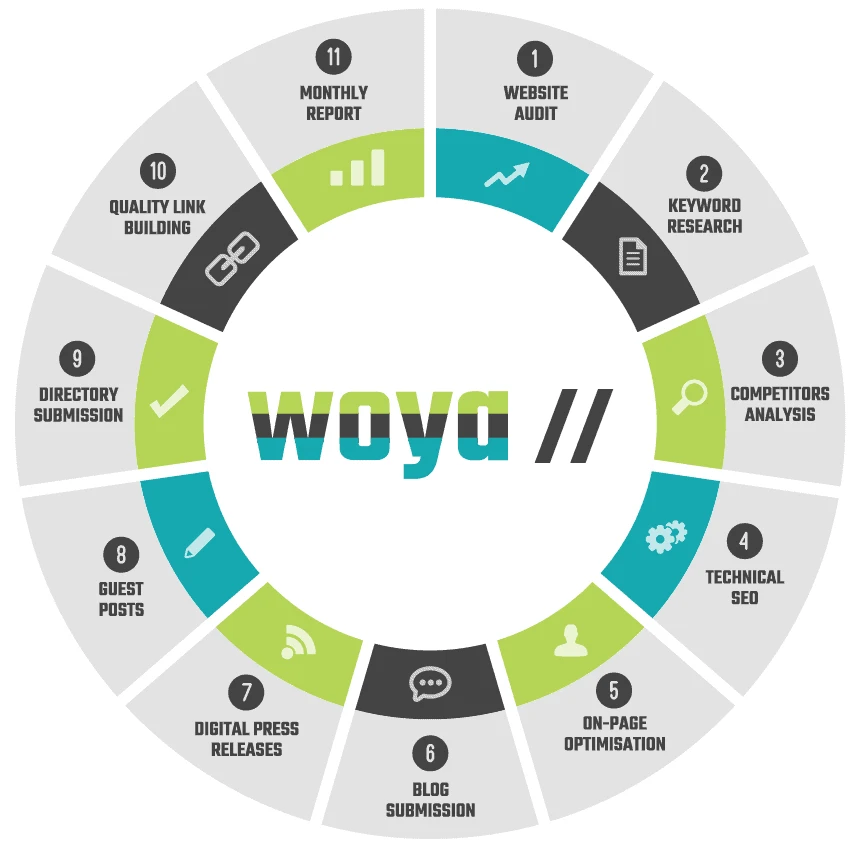


The Woya Wheel is what we refer to as our guiding pathway to organic search results success.

Profitable and well-performing search engine optimisation is made up of focus on a range of elements that, when combined and balanced, will boost SEO ranking and in turn, online visibility.

Where many businesses who refer to themselves as SEO ‘agencies’ actually only provide a single service (such as link building or accessibility optimisation), we at Woya Digital focus on on elements all in order to provide an all-encompassing SEO solution.

Driven by our expert team who specialise in all areas of search engine rankings and their years of experience and onward success, we created the Woya Wheel and apply it to every organic SEO strategy and campaign in order to develop and optimise successful search ranking results. The elements that make up the wheel include:

Website SEO Analysis

In order to begin to develop any SEO strategy, first the potential of the online presence must be established. This involves undertaking a full analysis of the existing website to understand best its strengths, weaknesses, opportunities and threats. This provides a baseline from which work can begin and allows for the full possibilities of success to be explored.

A website analysis does not always just take place at the beginning of any SEO marketing project, but instead should be revisited periodically to allow for new or amended strategies to form and further improvements to be made – especially in line with the ongoing updates and changes made to search engine algorithms.

SEO Keyword Research

While the days of ‘keyword stuffing’ website pages with as many relevant keywords and phrases as possible is now long gone, search engine algorithms still rely on the content of a website in order to understand what it is, who it’s for, and how well-presented it is for its users.

Woya Digital enact keyword research regularly in order to ensure that the content on the site is ever-current and that it fits the developing needs of user searches.

Recent Google updates have included the analysis of Natural Linguistic Programming (NLP) patterns as the way in which users search changes and develops all the time.

SEO Competitor Analysis

While the goalposts of SEO itself are always moving, so too are the activities, achievements and appetites of industry competitors. It is critical that businesses understand who their true competitors are in the online space – with the recognition that competing websites do not always equate to their ‘in-person’ competitors off line.

Woya Digital provides competitor analysis of competitor’s websites, social media, online presences and other SEO related activities to help our clients gain understanding and then advantage above them and ultimately, perform and rank higher within search engine results within which they appear.

Technical SEO

There is much ‘behind the scenes’ of a website that can be changed and improved in order to best demonstrate to search engine algorithms the authenticity, trustworthiness, relevancy and user experience of a site.

Technical SEO related activities include the creation and submission of site maps to Google (and other search engines as appropriate), creating an SEO-friendly site structure, improving loading speed issues, enacting mobile responsiveness changes for multi-device display and finding and fixing duplicate content issues.

On-Page SEO Optimisation

On-page SEO optimisation includes that of content already on a website to ensure search engines can read, understand and comprehend the site’s pages.

Woya Digital manages on-page optimisation across all websites including meta tags and descriptions, keyword usage, responsive formatting, internal linking, URL optimisation and sharing facilities.

Blogging and Guest Posts

To ‘blog’ has existed since 1994, and (contrary to some belief) is still an important element of SEO marketing. While the concept of blogging has evolved vastly since the 90s, it is used by organisations to present useful and shareable content aimed at its target audience; often to cement a brand reputation and position itself as an industry leader, and to add fresh new relevant content to a website – content is king!

A blog post can be published either on a business’ website itself or as a guest post on other relevant websites – and may be used directly as sales content or as more general marketing.

At Woya Digital we support clients both with content writing and creation, for publishing on site and for promoting to third parties in order to present guest posts on other domains.

Digital Press Releases

PR is no longer the domain of busy newsrooms but now primarily managed online by publications worldwide who need (and want) to access articles as quickly as possible in order to present onward to their own audiences.

Woya Digital provides a simple digital press release service which provides the potential of coverage and publicity across territories, targeted specifically to an audience segment or demographic.

The high quality backlinks achieved from such coverage can be hugely beneficial as part of an SEO campaign, with respected news services and websites on-board for partnership.

Directory Submission

SEO directories remain an important digital marketing factor, but the facilitation of submissions to directories must be carefully managed to avoid false or damaging listings.

Woya Digital maintains a database of only genuine and current digital directories, and will submit clients details to them in order to create one-way, regional and free backlinks.

Quality SEO Link Building

Quality link building is a critical element of search engine marketing. Working with our strategic partners across industries and the world, Woya Digital are able to build mutually beneficial business relationships to enhance the SEO credentials of all parties.

High quality, well-respected websites with good Domain Authority (DA) are the most effective links to receive, and our existing relationships allow for these to be created and maintained.

Monthly SEO Reporting

There is little point in investing in SEO marketing as a one off, search engine optimisation it is a moving target and something that requires continuous and consistent focus. Woya Digital provides easy-to-understand search engine results reports for all clients on a monthly basis.

Each report includes in-depth analysis alongside a quick overview for ease, highlighting the most relevant changes and explaining different aspects of search engine optimisation worked on.

If you’d like to start your spin of the Woya Wheel and learn how we can support your business with SEO efforts and to increase your website organic traffic, drop Woya Digital a message. The SEO journey starts here!

 

What Is Your Website Bounce Rate Telling You?

What Is Your Website Bounce Rate Telling You?

Reading Time: 4 minutes

SEO can seem a minefield, with a myriad of acronyms, jargon and industry terms to navigate and ever-changing goalposts of algorithm preferences, best practice protocols and software tools.

One such term amongst the many is ‘website bounce rate’. Let’s explain what it means, how important it is, and how it can be improved to boost overall SEO performance.

What is a Website Bounce Rate?

A website bounce rate is a statistic usually expressed in a percentage, and refers to the amount of users who arrive on a web page and then leave the site altogether without navigating through to another page, or taking an action on page.

Also known as a ‘single page session’, it gives an indication of the prevalence of those visiting a page, not taking any other action on the website, and leaving. This is considered a sign of the effectiveness of any given webpage on a site as, unless the desired effect for a page is solely to be read and then abandoned, its purpose is not being properly fulfilled.

What is Considered a Good Website Bounce Rate?

Website bounce rates vary hugely between industries and site types and so a perceived ‘good’ or ‘bad’ rate can be difficult to ascertain. The average website bounce rate online varies hugely, and so it’s near impossible to set a goal for a business’ online presence without some solid market research.

Website bounce rates also vary dependent on the device users are accessing the site from. Mobile devices result in an average bounce rate of 51% across all industries simply due to the brief nature of their typical usage, whereas tablets sit at around the 45% mark and desktop computers nearer 43%.

This means that it’s critical for businesses to take device usage into account, as they are more likely to have a higher website bounce rate if the majority of their users are using mobile devices. Traffic sources are also sometimes responsible for increasing website bounce rates, with visits originating from social media and paid ads often resulting in less engaged traffic.

It’s near impossible for any website bounce rate to be below 20%, as human behaviour simply can’t be accounted for, and so it’s not advisable for organisations to aim for 0%.

A bounce rate over 70% would, in most industries, be considered negative but is usually fairly easy to decrease as it’s often due to UX (User Experience) issues: such as poor design, excessive bots, browser incompatibility or tracking code errors.

How Website Bounce Rate Interacts with Other Aspects of SEO

There are many aspects to the overall discipline of SEO (Search Engine Optimisation) and so it’s worth noting that website bounce rate is just one of many factors that contribute to digital activity, presence and performance.

Technically, website bounce rate doesn’t directly influence page ranking – but it is an indirect factor.  Higher bounce rates are often indicative of a UX issue that will impact on the overall performance of the site and demonstrates its usefulness to the algorithms of search engines.

How Overall Time-On-Site Affects SEO

Similar to website bounce rates, the time on-site (also known as the dwell time) is the amount of time a user spends on a web page or site before clicking elsewhere. A very low dwell time indicates that the page doesn’t meet the user’s search intent, and a longer dwell time shows genuine engagement. This metric demonstrates to search engines the authenticity, topic and overall usefulness of the website and so longer times are considered bette, but after 30 minutes of inactivity on a site, the session ends to account for untrue inflation due to windows/tabs left open unintentionally.

Website bounce rates and dwell times are different measures but both allow marketers and webmasters to understand user satisfaction and engagement with the content created.

What Bounce Rates Tell Us About a Site/Page

A website’s bounce rate can be considered a reliable informant factor of a page’s perceived value by users. Where a bounce rate is high or conversions aren’t happening where desired, new approaches can be trialled as the existing content obviously isn’t landing correctly with its audience.

One important metric to monitor is bounce rates from content that’s being linked to as a part of a paid campaign, as this can demonstrate the ROI (Return On Investment) on money spend. High bounce rates or low conversions from paid ads indicate a disconnect between the advert and the landing page and may result in wasteful expenditure unless the issue is addressed and resolved.

Website Bounce Rates Should Be Constantly Monitored

People change, attitudes change, online best practices change and website bounce rates change – and this is exactly why bounce rates need to be monitored on a continuous basis and not just as a one-off measurement of website performance.

With the algorithms behind search engines being constantly updated as well as consumer behaviours shifting, it’s not unheard of for bounce rates to ebb and flow, too. A rapidly changed website bounce rate can indicate a sudden website error or issue and so may be the first symptom of a problem that can be rectified swiftly.

Get Support With With Your Website and SEO

If you need to improve your website’s bounce rate or just need to understand where it currently sits and why, a specialist SEO company such as Woya Digital can help you comprehend things – and better your position.

Bounce rates are often easily shifted into more positive territory with a little knowhow, and with the expert team at Woya on-board, you can be sure of a move in the right direction.

What Is The Google Algorithm, and How Does It Work?

What Is The Google Algorithm, and How Does It Work?

Reading Time: 5 minutes

Businesses worldwide are competing to rank highly on Google search and other search engines, and the internet is full of tips for ranking number one on SERPs (Search Engine Results Pages), SEO tips and tricks and ways to influence the Google search algorithm behind-the-scenes to do better without having to pay for traditional web advertising.

Indeed, much is said about the Google algorithm and how it works, but here we present the facts: in order to best help you strategise your SEO and plan it to benefit your digital presence.

What is the Google Search Algorithm?

The Google search algorithm is a complex system of programming and coding used to retrieve data from its search index which can then present the most appropriate search results for the search queries made by the search engine user.

Google’s ‘crawler’ bots index the internet and store the data on what it thinks each web page is about, what purpose it serves and who the appropriate audience for its content are. The Google algorithm then works through the index it has created to deliver web pages ranked by relevance on its SERPs. Google’s search algorithm prioritises and marks out relevant results it believes best suited to the user’s search intent to give them the answer, information or data they’re trying to find.

What is an Algorithm?

Algorithms are now referred to often as consumers better understand the internet and the presence they hold on it, and in many circles are seen as a mythical beast to be defeated in order to get more likes, gain more exposure, get more traffic, or be ranked above competitors in search query rankings.

While indeed it is true that only a very few senior coders at any tech company will know the exact details of a website’s algorithm and its calculations, much of what an algorithm follows can be worked on through common sense.

In general terms, an algorithm is a set of rules to be followed in calculations by a computer program. For example, the Google’s search algorithm is the program that calculates which webpages rank where for a specific user search query made. In the case of Instagram, the algorithm is the program that calculates which users are presented with which content. In the case of TikTok, the algorithm is the program that calculates what the user is interested in, and features videos related to this in their feed.

Every website or program that has a bespoke user ‘feed’ will have an algorithm operating behind it.

How Does Google’s Algorithm Work?

Google search algorithm works by referencing its search index and analyses the factors upon each page to determine its relevance for ranking. While we don’t know the exact weight that Google puts behind each of the many factors of a webpage, we do know what constitutes a priority for SEO purposes. This includes:

    • The exact search terms of the query made on the search engine
    • The domain age, authenticity and domain authority (DA)
    • The usability of the website including its loading speed, accessibility functions and security
    • The mobile responsiveness of the site’s performance and its ability to switch format to one appropriate to the device on which its being viewed
    • The keywords and topics used throughout the content on the site, and if there is relevant content
    • Other websites that link to the site and how trustworthy they are.

Considering all of these factors, the Google algorithm judges which website pages are most appropriate to be featured and in what order.

This means that the more concise, clear and usable a site is, the higher it will rank when a relevant search query is made.

Google Algorithm

What are Algorithm Updates?

Of course, as with all tech, the Google algorithm is constantly changing to improve the service it delivers. While there are a couple of major updates made every year which cause a considerable shift to the algorithm and its programming priorities, its estimated that smaller algorithm updates are made around once a week!

Where a major update does occur (referred to as a broad core algorithm update), Google announces this ahead of time and provides some basic details on it so that businesses are able to prepare and shift their online practices to meet the new ranking factor requirements.

Top Factors of the Google Algorithm

No one knows exactly what the exact formula is for Google top ranking factors, as this information remains confidential to all but a few senior execs within the company. However, we do know that the following ranking factors are amongst the most important:

    • High-quality content
    • A mobile-first experience
    • Page experience
    • Page loading speed
    • On-page optimisation
    • Internal links between pages
    • External links to and from other relevant sites.

Historically focus has been laid just on the usage of keywords and search query phrases but since Google’s technology has developed and improved, many more factors are now included and considered. While there are businesses who do continue just to rely on the same keywords and keyword repetition throughout their content, this can no longer form a comprehensive and strategic SEO approach.

Realistically, it doesn’t matter exactly which ranking factor is the most important, as all should be focused on with equal priority in order to develop a well-rounded user experience (UX).

What is the Latest of the Google Algorithm Updates?

The most recent minor Google updates were both in September 2022. One was a core algorithm update and the other focused on new product reviews. The latter didn’t offer any particular advice for site owners but the former was covered in an entry on the Google Search Central Blog. This advised that the update wasn’t anything for webmasters to worry about or that they should need to take direct action, but that high quality content was being uprated in its priority rating.

The most recent major Google broad core algorithm update was in August 2022 and was known as the Google Helpful Content Update. This focused on the concept of ‘people first content’. This update advised businesses to strive toward content creation for a target audience with their search intent and needs in mind, rather than the common approach of creating content simply for SEO purposes and because the business assumed that their website’s ranking would benefit from the repeated use of keywords and phrases.

While other small algorithm updates take place in Google weekly (if not daily), these do not require any specific action and businesses can consider their existing SEO efforts sufficient to weather such changes.

How Does the Google Algorithm Affect SEO?

The Google search algorithm is what businesses are speaking to when they enact their SEO strategies, and must ensure that relevant, accurate and clear information is conveyed throughout their site in order for the algorithm’s programming to best understand it.

This means that continuous improvement of all the website’s page factors must be made a digital marketing business priority, in order to rank as high as possible and ideally do so above competitors. While it may not prove productive for businesses to focus too much on the search algorithm and what it demands, it can make for a great foundation from which companies can understand what smart content creation and a positive UX means.

Get Support to Manage Your Business Google Ranking

Of course, not all businesses can hire a full-time SEO lead to work in-house. That’s why businesses choose to work with Woya Digital.

Our team of SEO specialists stay at the forefront of Google’s updates and best practices in order to ensure our clients gain competitive advantage and receive great exposure to both new and existing customers. Get in touch with our team to discuss how we can support you and to best understand what impact this could have on your bottom line.

What is Google Indexing in SEO?

What is Google Indexing in SEO?

Reading Time: 5 minutes

Businesses simply can’t afford for their website to not be listed on Google. With the Google search giant processing over 99,000 searches every single second, the potential is extremely important.

But for Google search results to list a website or page, it must first know it exists and match it up to relevant search terms ‘behind-the-scenes’ using its algorithm programming. This is called Google indexing.

But how does this happen and what is its relevancy to an overall SEO strategy?

What is Google Indexing?

Search engine indexing (or Google indexing in the case of Google), is the automated process of a system collecting, parsing and storing data it finds online. This data is then stored in the Google search index database so that when a search engines user carries out a search, Google can reference this index for the appropriate information and indexed pages, rather than scouring the entirety of the internet every time.

Google indexing is a highly complex process and incorporates interdisciplinary concepts from computer science, cognitive psychology, mathematics and probabilities, informatics and even neuro-linguistic programming.

Why is Google Indexing Important?

Google is the world’s biggest search engine, with a market share of over 90% worldwide. This means that even if it isn’t the most popular search engine in a business’ target location, it is still simply too large to ignore when it comes to strategizing for digital marketing.

If Google doesn’t undertake crawling and indexing on your website, it won’t just not rank well on Google – it won’t rank at all on Google.

If businesses don’t ensure that their digital presence is listed on Google in some way, shape or form they will lose competitive advantage to brands who are listed, who will benefit from the massive traffic that ranking well on the Google search engine can bring.

While not all other sites rely on Google’s search index in particular for their search results, several other systems do, and so it should not be discounted even if it isn’t the primary target system.

How Does Google Indexing Work?

Google indexing takes place when Google’s ‘crawlers’ (that is, automated software programs) visit publicly accessible website’s pages and follow their links.

This helps them travel from page to page and store information on what the pages on your site are about, who they’re for and what they’re aiming to do. The Google algorithm also judges the the site/all of your pages on their User Experience (UX), performance, accessibility and content quality to ascertain how and for what the site should rank when users completes a relevant search.

Google indexing can only happen if a website is publicly available. If it requires a log-in, is in a test environment or is ‘hidden’ from public consumption, this will prevent Google’s ability to read the site and it will remain un-ranked. This allows businesses to present exclusive content to subscribers or members but does mean that anything they wish to include on search engine rankings must be prioritised for public pages.

How Do Search Engines Work

How to Tell Google to Index Your Site

If a website or page has yet to be indexed by Google, the webmaster can request that the crawlers navigate it on the next occasion they’re able to. To do this, a webmaster tells Google through the Google Search Console tool and the crawlers will index the page/s whenever possible.

Where webmasters or digital marketers wish to rank, they should prioritise Google indexing as once a site has been crawled it will be periodically re-visited, so can be ranked on search engine results pages even before the full site content has been populated.

How Long Does Google Indexing Take?

There’s no one-size-fits-all timeframe for Google to index a website, although generally it takes longer for larger sites with more content than it does individual pages with little or short-form content.

The amount of time it takes to get a site indexed is influenced by Google’s current workload (ie it will take longer during periods where a major update or change is being rolled out), but also how many websites are being submitted for indexing at any one time.

Anecdotally, webmasters and digital marketers state that it has taken anywhere from 4 days to 6 months to get their site indexed for the first time. However, this is almost always expedited by requesting indexing through the Google Search Console (as mentioned above), so this is recommended.

Duplicate content will harm the quality of your site and Google will penalise you for this.

How Does the Process of Google Indexing Relate to an Overall SEO Strategy?

Any digital marketer embarking on enacting an SEO strategy should prioritise Google ranking as an effective way to gain targeted organic traffic. In order to best ensure adequate and appropriate ranking for relevant searches, all websites should be subject to timely, consistent and pertinent new content upload as well as hosting a clear sitemap, offering mobile responsiveness and ensuring fast load times.

Google indexing can be considered the foundation for an SEO strategy. Once the site and all the pages have been indexed, a more thorough online presence can be built using target keywords and advertising, further new content creation and an increased focus on the overall User Experience.

How To Fix Indexing Issues

It is not enough for webmasters to create web pages and just expect them to be crawled and indexed by Google, instead there are a variety of best practices they should look to meet. If any of the following issues are experienced, they can be easily rectified by doing the below:

Site is not indexed because it’s too new – you can still request indexing through Google Search Console, but a newer domain is unlikely to get higher rankings than an older one as its authenticity and trustworthiness can’t yet be fully verified. As more website content is added and the site ages, it will be re-indexed and re-prioritised.

A recent redesign should have improved SEO, but hasn’t – it may simply be that Google hasn’t re-indexed the site since it has been improved. A request for re-indexing can be submitted through Google Search Console.

A sitemap wasn’t in place when the site was indexedall websites should have a sitemap somewhere in order for Google to easily crawl its pages. If, for whatever reason, this wasn’t the case when the indexing happened, the site map can be submitted directly to Google through the Google Search Console tool and then it’ll be re-read the next time the site is crawled.

Site isn’t mobile responsive – Google prioritises websites that provide a good User Experience over those that don’t, and so if a site isn’t mobile responsive, Google is very unlikely to favourably rank it. In this instance, the webmaster should seek out a redesign of the site to ensure better accessibility.

Where to Get More Help with Google Ranking

At Woya Digital we have a whole team of SEO specialists who work around-the-clock on keeping up with Google’s latest updates and developments.

We work not just for but also with our customers to ensure their SEO goals are met and that their online presence works perfectly to fit their needs and wants, as well as the idiosyncrasies of their business and target audience.

Why You Must Include Long Tail Keywords In Your SEO Strategy

Why You Must Include Long Tail Keywords In Your SEO Strategy

Reading Time: 4 minutes

Search Engine Optimisation (SEO) is not just a ‘nice to have’ marketing tool for businesses presenting online – it’s not an option! Showing up in the right place at the right time digitally for customers searching online, is critical for any organisation wishing to gain competitive advantage, remain relevant and grow its audience.

The discipline of SEO covers a wide of variety of topics, but a prominent one is keywords. Here specifically we’re going to flesh out long tail keywords!

What Are Long Tail Keywords?

Most keywords refer to a single word or couple of words that match together to create a searchable phrase that users type into a search engine in order to find results. Long tail keywords are formed of between three and five words usually (though no such numeric limit actually exists) and are, by their nature therefore, more specific and less common.

The term ‘long tail keyword’ comes from a book called The Long Tail by Chris Anderson, which focuses on the niche of markets and products, and how successful focusing on a specific sector or area can be.

For example, a standard keyword search may be ‘pink trainers’ but a long tail keyword search would be ‘pink Nike trainers size 5’.

How Do Long Tail Keywords Work?

The longer nature of long tail keywords compared to briefer search terms means they are more specific and will as a result drill down more specific (and hopefully relevant) search results. For search engine users, they present an opportunity for more appropriate results and ideally, less clicks to find exactly what they want. For businesses, they present an opportunity to target more niche markets.

Generally speaking, long tail keywords are less competitive than more generic keywords because they’re designed to better reflect how users make queries. They are more likely to attract high-quality traffic to a website, which is likely to increase conversion rates.

Often, long tail keywords aren’t the first search query typed in by search engine users. It is not uncommon instead for users to type in a more generic search term, uncover generic results, and then use long tail keywords to drill down to more specific results.

How Do Keywords Form Part of an SEO Strategy?

Statistics suggest that over 70% of all search queries are now made using long tail keywords, with voice search being a key factor in consumer behaviour.

Users are more likely to use the same types of phrasing they would in colloquial speech, in such searches – an evolving behaviour recognised and catered for by Google with their focus on NLP (Neural Linguistic Programming) in search algorithms to produce relevant results. This high level of long tail keyword search means that including these keywords in an SEO strategy is imperative.

Long tail keywords should be used to create blog posts, web pages and other relevant content to explain the specific topics within the agreed product or service pillars of the business. Together, the relevant long tail keywords should create a cluster of information around each pillar topic, with the algorithms behind the search engines depending on these to connect users with exactly the details they’re looking for.

Once uploaded, businesses should monitor the performance of each piece of content and continue to produce relevant content around areas of both shortfall (to bridge the gap and supply info where it doesn’t already exist) and success (to continue to build upon the content that users find useful).

Long tail keywords should be focused on alongside other keyword types, as part of an overall concerted effort to improve a websites content quality and quantity.

Different Keyword Ranking Difficulty Levels

The most commonly used generic search terms, by their nature, have the most competition online. This means that it is difficult for businesses to rank highly for them.

Long tail keywords tend to be easier for businesses to rank highly for as they’re searched less and are considerably more specific. Generic search terms sit at the head of search, a tiny number of keywords with exceedingly high search volumes. Long tail keywords constitute millions of search terms all with very low search volumes. This leaves the opportunity for digital marketing and content production around long tail keywords to be more prevalent and more prosperous.

The type of keyword being used or focused on isn’t the only factor that contributes to the difficulty or ease of ranking. Other such determinants include the content type, the Domain Authority (DA) of the website on which the content is published and the links to and from the content piece.

How To Identify Relevant Keywords To Focus On

There are various tools for keyword research, all of which will advise of relevant keyword combinations (both generic and long tail), their competition levels, search volumes and CPC (Cost Per Click) fees. However, these research tools should be used with caution as oftentimes they are created independent of tangible human input and can be based around theory rather than actual user behaviour, particularly in fields where the relevant keywords may include an ambiguous word or phrase.

Ideally, once identified, businesses should look to target long tail keywords that are low in competition and high in volume.

It is not enough to just look up keywords and produce content including them. Instead, businesses should look to incorporate long tail keywords into a thorough SEO strategy that looks to improve all areas of a website’s accessibility and relevancy, and includes regular content creation as part of this.

At Woya Digital, we have a team of SEO experts who work on creating tailored SEO strategies to best improve our customers’ competitive advantage. Get in touch to learn more!