Why You Must Include Long Tail Keywords In Your SEO Strategy

Why You Must Include Long Tail Keywords In Your SEO Strategy

Reading Time: 4 minutes

Search Engine Optimisation (SEO) is not just a ‘nice to have’ marketing tool for businesses presenting online – it’s not an option! Showing up in the right place at the right time digitally for customers searching online, is critical for any organisation wishing to gain competitive advantage, remain relevant and grow its audience.

The discipline of SEO covers a wide of variety of topics, but a prominent one is keywords. Here specifically we’re going to flesh out long tail keywords!

What Are Long Tail Keywords?

Most keywords refer to a single word or couple of words that match together to create a searchable phrase that users type into a search engine in order to find results. Long tail keywords are formed of between three and five words usually (though no such numeric limit actually exists) and are, by their nature therefore, more specific and less common.

The term ‘long tail keyword’ comes from a book called The Long Tail by Chris Anderson, which focuses on the niche of markets and products, and how successful focusing on a specific sector or area can be.

For example, a standard keyword search may be ‘pink trainers’ but a long tail keyword search would be ‘pink Nike trainers size 5’.

How Do Long Tail Keywords Work?

The longer nature of long tail keywords compared to briefer search terms means they are more specific and will as a result drill down more specific (and hopefully relevant) search results. For search engine users, they present an opportunity for more appropriate results and ideally, less clicks to find exactly what they want. For businesses, they present an opportunity to target more niche markets.

Generally speaking, long tail keywords are less competitive than more generic keywords because they’re designed to better reflect how users make queries. They are more likely to attract high-quality traffic to a website, which is likely to increase conversion rates.

Often, long tail keywords aren’t the first search query typed in by search engine users. It is not uncommon instead for users to type in a more generic search term, uncover generic results, and then use long tail keywords to drill down to more specific results.

How Do Keywords Form Part of an SEO Strategy?

Statistics suggest that over 70% of all search queries are now made using long tail keywords, with voice search being a key factor in consumer behaviour.

Users are more likely to use the same types of phrasing they would in colloquial speech, in such searches – an evolving behaviour recognised and catered for by Google with their focus on NLP (Neural Linguistic Programming) in search algorithms to produce relevant results. This high level of long tail keyword search means that including these keywords in an SEO strategy is imperative.

Long tail keywords should be used to create blog posts, web pages and other relevant content to explain the specific topics within the agreed product or service pillars of the business. Together, the relevant long tail keywords should create a cluster of information around each pillar topic, with the algorithms behind the search engines depending on these to connect users with exactly the details they’re looking for.

Once uploaded, businesses should monitor the performance of each piece of content and continue to produce relevant content around areas of both shortfall (to bridge the gap and supply info where it doesn’t already exist) and success (to continue to build upon the content that users find useful).

Long tail keywords should be focused on alongside other keyword types, as part of an overall concerted effort to improve a websites content quality and quantity.

Different Keyword Ranking Difficulty Levels

The most commonly used generic search terms, by their nature, have the most competition online. This means that it is difficult for businesses to rank highly for them.

Long tail keywords tend to be easier for businesses to rank highly for as they’re searched less and are considerably more specific. Generic search terms sit at the head of search, a tiny number of keywords with exceedingly high search volumes. Long tail keywords constitute millions of search terms all with very low search volumes. This leaves the opportunity for digital marketing and content production around long tail keywords to be more prevalent and more prosperous.

The type of keyword being used or focused on isn’t the only factor that contributes to the difficulty or ease of ranking. Other such determinants include the content type, the Domain Authority (DA) of the website on which the content is published and the links to and from the content piece.

How To Identify Relevant Keywords To Focus On

There are various tools for keyword research, all of which will advise of relevant keyword combinations (both generic and long tail), their competition levels, search volumes and CPC (Cost Per Click) fees. However, these research tools should be used with caution as oftentimes they are created independent of tangible human input and can be based around theory rather than actual user behaviour, particularly in fields where the relevant keywords may include an ambiguous word or phrase.

Ideally, once identified, businesses should look to target long tail keywords that are low in competition and high in volume.

It is not enough to just look up keywords and produce content including them. Instead, businesses should look to incorporate long tail keywords into a thorough SEO strategy that looks to improve all areas of a website’s accessibility and relevancy, and includes regular content creation as part of this.

At Woya Digital, we have a team of SEO experts who work on creating tailored SEO strategies to best improve our customers’ competitive advantage. Get in touch to learn more!

How Do Search Engines Work?

How Do Search Engines Work?

Reading Time: 6 minutes

Just about the whole world now relies on online search engines to look up information, compare products and services, and search for … anything really!

To ‘Google’ has become a verb, the behaviour of looking something up online has become the norm for many in the quest for data and some 8.5 billion queries are made to Google every day.

But how do search engines work and how is best to take advantage of them to benefit your business?

What is a Search Engine?

When asked what a search engine actually is, many would simply respond with the name ‘Google’, but in fact there are many search engines and while all do slightly vary, their premise is the same.

A search engine is a software system designed to allow users to search the internet for specific information. This is usually done via a textual web search query, in which the user types keywords into the search engine and is presented with a line of results on a SERP (Search Engine Results Page). The results are usually provided ranked with the most likely to be accurate and useful for the user’s search queries.

While what we think of as search engines are often websites such as Google and Yahoo, such software also exists to search through the content of individual websites and databases.
How Do Search Engines Work

What Happens when a Search is Performed?

When a search is performed, the system reviews its index of web pages to find those it believes are relevant to the search. This judgment is carried out by a program known as a search engine algorithm, which identifies the most relevant results to the search query and then presents these search results on a SERP.

In most cases, the search engine will review its index of web pages regularly in order to ensure it is always presenting the most up-to-date content possible. It will also update its algorithm often in order to maintain current technology and continuously improve the results presented.

The time between the search query being input and the web page index being scoured for relevant results usually takes just seconds; and often just a fraction of a second.

What is a Search Engine Algorithm and What is its Purpose?

Lots is spoken about the algorithms used across search engines and social media but it seems that genuine understanding of them is very low.

A search engine algorithm is a computer program that runs on a collection of formulas to determine the quality and relevancy of a particular web page or advert to a keyword or phrase that may form part of a user’s search query.

The purpose of an algorithm is to provide the most appropriate search results possible for the user, which in turn result in the users being more likely to return to the search engine again and it being able to gain competitive advantage above others. For this reason, search engine algorithms are frequently updated and improved: with Google updating theirs an estimated twice a week minimum!

What are the Most Popular Search Engines?

Google holds over 92% of the world’s search engine market share, but there are other search engines that hold significant share in particular geographic locations. Bing, owned and operated by Microsoft, is considered the nearest competition to Google and holds around an 8% market share. Baidu is the third largest globally, but this is largely due to its dominance in China, where it holds around 73% of the total market. Generally speaking, any business looking to market in China or the surrounding territories needs to ensure they have tailored their search marketing practices to Baidu rather than Google.

Other major search engines include Yahoo, Yandex, Ask, DuckDuckGo, Naver, AOL and Seznam.

As a result of Google’s market dominance, most business’ search marketing and SEO (Search Engine Optimisation) efforts focus toward it and it’s considered the status quo in the western world to tailor search strategies exclusively for this, with other search engines not considered a priority.

How Do Search Engines Differ?

While all search engines do run on the same basic premise of indexing websites and then carrying out the analysis of these websites using an algorithm to present appropriate results, they do vary in the way in which they carry out this analysis.

Google’s algorithm has developed hugely over the last ten or so years and now lands its focus on matching up the intent behind the search being made and the results, whereas Bing continues to spotlight on the keywords being used as a baseline.

Yahoo has been powered by Bing since 2011 and so displays search results using much of the same criteria as it. Yahoo places more importance on domain age than Bing, but similarly focuses on keywords and meta data.

In China, Google and all Google products are banned; leaving Baidu as the most important search engine in the country. While Baidu’s algorithms can be considered not entirely dissimilar to Google’s (there is a large amount of AI and intent-based calculations utilised), the system behind Baidu actually analyses web content to a higher degree than Google and so can take a little longer to update initially. Baidu really only works well in simplified Chinese and prioritises those domains registered in China above anything not local to the country or its borders; and is very heavy on censorship.

How Do Search Engines Provide Search Results So Fast?

Search engines are able to scour millions of sources for analysis and ranking in a fraction of a second in order to present adequate and appropriate search results, and the key to this speed is all based around its ability to index.

When a search engine crawlers ‘crawl’ and index the web, they essentially create a database for that search engine to use. This negates the need for them to search the entire internet every time a query is made and instead provides their own resource to search through.

Consider being asked for a chow mein recipe, rather than go and take out every book in the library on Asian cuisine and leaf through them, you can grab the most appropriate title, skip to the index and look up ‘chow mein’ under C. With everything already well categorised, it’s considerably easier and quicker for the search algorithms behind-the-scenes to categorise and analyse the information at hand.

Google won’t comment on the exact size of its indexed internet records but has admitted that it’s over 100 million gigabytes in size, and realistically, it’s probably several times that. To give you an idea of how big that is, it’s 100,000,000,000,000,000,000 bytes! However, it’s worth noting that only a handful of people employed by Google have a true idea of the exact technology behind the Google index, and many of those working on search algorithms aren’t informed on how all areas of the business work together to produce the results they do.

How to Tell Search Engines to Crawl your Website

For a website to appear on a search engine, it must be included in the system’s ongoing list of indexed pages; or it is not able to analyse it for relevant content when a search query is made.

Firstly, any ‘noindex’ tags from the coding and programming of the website must be removed. These tags direct search engines to bypass the domain’s content and so don’t allow search engine bots to ‘crawl’ the pages and add it to their index. Businesses may wish to keep these tags in place until their website content is complete, but at this point should remove them entirely.

In order to optimise the way search engine algorithms are able to crawl a site, it should have a site map and a full robot.txt file.

For Google indexing, websites can be submitted directly to the search engine using the Google Search Console. Domain ownership will need to be verified.

For Bing indexing, websites can also be submitted directly through their Bing Webmaster Tools: and if a Google Search Console entry already exists, this can be copied straight across. Submissions to Bing automatically index to Yahoo, too.

DuckDuckGo automatically indexes the internet and so doesn’t require any formal submission, although it prioritises those results on Bing, and so if a Bing submission has been made, it will be picked up quicker than those not listed on that system.

To index a site to Baidu, a localised site in simplified Chinese with either a .com or .cn domain will need to be created. This can then be submitted directly through Baidu Webmaster Tools.

Where to Get Help with Search Engine Optimization

If you’re not sure which search engine is best to target your SEO and search marketing practices toward, or think that you may need to branch out a little with your efforts, get in touch with Woya Digital. Our in-house team of SEO experts can help advise, guide and draw up a strategy to maximise exposure and success online.
 

What is Search Intent in SEO, and Why Does It Matter?

What is Search Intent in SEO, and Why Does It Matter?

Reading Time: 4 minutes

The practice of SEO (Search Engine Optimization) is growing ever more comprehensive as the programming and algorithms behind search engines become cleverer and more complex.

At the heart of this all is the need for search engines to present the most relevant possible search results for users, and it’s this that they base all of their systems and processes around.

Search intent forms the basis from this and from there, all efforts are focused.
Search Intent User Intent Audience Intent

What is Search Intent?

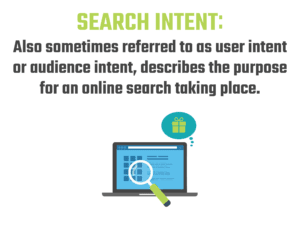
Search intent, also sometimes referred to as user intent or audience intent, describes the purpose for an online search taking place.

The reason that anyone conducts a search online likely dictates the most appropriate results for it. For example: is the user looking for information? Do they want to make a purchase? Are they searching for a particular brand name and only that website will do? The user’s search intent is the ‘why’ behind the action being completed.

The Four Types of Search Intent

There are four primary types of different search intent, each with its own purpose. These are:

Informational

Those conducting informational searches are looking to find some specific information. These searches are often, but not always, framed as questions, with informational keywords, and can be simple or fairly complex. Searches made with informational intent include those such as:

–        What is the capital of Morocco?

–        Directions to London Luton Airport

–        How does blockchain work?

–        How do you say hello in Mandarin Chinese?

Navigational

A search made with navigational intent is done to find a specific website or web page. The user already knows where they want to go but either don’t know the URL to type in directly to the address bar or find it quicker or easier to search for it instead with navigational keywords. Searches made with navigational intent include those such as:

–        Twitter

–        Peugeot official website

–        LinkedIn login

–        BBC news headlines.

Transactional

A user searching with transactional intent is looking to make a purchase and in many cases, already know what it is they’d like to buy and are looking for a retailer to buy it from. Searches made with transactional keywords include those such as:

–        Buy MCFC kit

–        Newest iPad cheap

–        John Lewis coupon

–        Zoom pro subscription.

Commercial Investigation

When a user is searching with commercial intent, they are also looking to make a purchase but have not yet decided which specific product or service they’re going to buy. This is part of the user journey online ahead of a transactional search, and may find the user searching for reviews and comparisons as they seek to make an informed purchase decision. Searches made with commercial investigative intent include those such as:

–        Best vegan eyeliner

–        Macbook Pro review

–        Plumber near me

–        Trustpilot vs Feefo.

Why is Search Intent Important?

Google’s number one goal is matching search intent of their users with relevant search results, in order to ensure they are providing as accurate and appropriate search result pages as possible, to continue their reign as the most successful search engine in the world.

When content on a website is properly tailored toward an audience’s search intent rather than simply whatever message it is the business wants to convey, they are able to meet their user’s needs by satisfying search intent: demonstrating relevancy, authenticity and helpfulness to Google’s algorithms. These factors all feed into the overall SEO ranking and are likely to boost the position of the webpage, as well as increase conversions and time spent on the domain as well as lowering bounce rate.

Realistically, if a business isn’t able to adapt and create content to meet the needs of user’s search intent, they’ll find that they’re unable to cater appropriately for their target audience, and that audience will move to other online domains, including likely those of their competitors.

How to Identify Search Intent

Search intent can often be identified through the language used in the search. For example, the word ‘buy’ is only likely to be present in a search made with transactional intent, and ‘how to’ in a search with informational intent.

Generally speaking, you can determine the search intent behind a search if it includes the following language:

Informational intent: who, what, where, when, why, how, guide, tutorial, resource, ideas, tips, learn, examples.

Navigational intent: brand name, product name, service name.

Transactional intent: best, good, top, review, testimonial, comparison, product attribute (such as colour/size/specific feature).

Commercial investigative intent: buy, coupon, voucher, order, shop, purchase, price, cheap.

Of course, this isn’t necessarily accurate at all times dependent on the exact phrasing of the search, but it forms a good guideline. If a business is using a keyword research tool they may be able to filter relevant search terms by intent.

 Google’s Guidelines on Search Intent

Google has provided exact guidelines on search intent and how webmasters can and should understand and work with it. These are known as the Google Quality Raters Guidelines.

Google employs quality raters who conduct search queries online before rating how appropriate and accurate the results they are served with were for their search intent. The guidelines that inform these raters highlight the importance of search intent along with the different types of intent and the impetus that Google puts onto intent, but explains that intent may vary between location, time and device.

For example, a search for a supermarket on a mobile device is likely to be a user looking for a nearby location, but on a desktop or laptop computer is more likely to be intended for an online order. When the search is made early in the morning or late at night, it’s more likely to be an enquiry for opening hours. The intent varies based on the way in which the search is made.

All of this signifies the prestige that Google holds behind user search intent, and how it builds its algorithms and systems around it to meet these needs. This includes the introduction of the Google BERT update in 2019 which focused on natural linguistic programming to inform the search engine of the intent behind the search and help more accurately convey appropriate results.

How to Optimise to Meet Search Intent Needs

Businesses can best analyse and optimise their digital presence to meet user search intent needs through collaborative working with an SEO specialist. At Woya Digital, we have a team of SEO expert professionals in-house who analyse business’ web presence entirely bespoke: taking on each job as an individual entity and never applying a one-size-fits-all approach.

We can help you meet the needs of both your potential and existing customers online through content optimisation to meet the needs of their search intent – raising your organisation’s profile, rank and success online all at the same time.


How to Create a Simple SEO Content Strategy

How to Create a Simple SEO Content Strategy

Reading Time: 4 minutes

Search Engine Optimisation (SEO) is an ever-changing discipline that requires continued activity and effort in order for businesses to remain at its forefront. With over 3.8 million searches happening on Google per minute worldwide, businesses who need to gain and maintain competitive advantage above others need to ensure that SEO remains a digital marketing priority.

To centre SEO appropriately, it is critical that an SEO content strategy is put together and followed.

Why is SEO Important for Businesses Online?

Whether or not a business sells its products or services digitally is no longer a consideration when it comes to having an online presence – because no matter how an organisation operates, consumers will expect to be able to find information about them on the internet.

This means that even if a business’ web presence is minimal, it needs to have one, and such presence needs to include relevant details for their customer base. Never have marketplaces worldwide been so crowded, so in order to maintain (if not grow) an audience, all businesses must ensure they appear in the appropriate place digitally.

‘Googling’ is now a colloquial verb and consumers of all ages defer to looking for information they need online rather than through manual means. With some 5.6 billion searches happening every day on Google alone, search engines are now very much the data source of choice – and if businesses aren’t there, they will surely lose out to their competitors who are.

What is an SEO Content Strategy?

A key part of SEO is to produce and publish content online that is relevant to a brand’s products and services, appropriate and helpful for their audience and shareable for onward promotion. This usually includes the creation of blogs, press releases, infographics, data sheets, videos and other content for user consumption.

An SEO content strategy provides a coherent plan for businesses to follow with their content creation. This action plan can be used to ensure content is appropriate, regular and of a quality high enough for onward sharing and publication as an organic marketing tool.

Why an SEO Content Strategy is So Important

Working to a thorough SEO content strategy holds many benefits:

Free Search Rankings
Organic search, search result placements that have not been paid for, is heavily influenced by a website’s content and so a comprehensive SEO content strategy helps promote ranking success. While businesses can choose to pay for placements, organic search results are considered more powerful and are more likely to receive click-throughs and genuine conversions.

Guaranteed Quality Content
A proper SEO content strategy will allow a business to ensure that they are producing relevant, regular, high-quality content that is appropriate for their audience. Continued monitoring of content performance will allow for further content production two-fold: where there is a gap or shortfall in information available, and the re-purpose of content where it is already found to be useful and successful for its audience.

Maintained Relevancy
It is, unfortunately, quite common for businesses to begin to focus on SEO and get swept away in content creation that is only broadly related to their brand and not niched enough to be considered helpful by the target audience or segment, therefore resulting in a waste of time and resource for little tangible result. Following a comprehensive SEO content strategy helps ensure that all SEO activity is directly targeted and ‘on-message’ for the optimum chance of success.

The Main Elements of an SEO Content Strategy

A thorough SEO Content Strategy will comprise of several elements. These include:

Relevant Keywords
It is important for businesses to properly research which search terms their potential and existing customers are using in order to look up relevant products, services and brands. Once completed, keyword research will provide a list of targeted terms for each pillar of the business, and content can be crafted around these, giving users a higher chance of arriving on the business’s webpage for the term.

Matching Search Intent
It’s important to create content that matches the intent of the search being placed. For example, content to match a search query beginning ‘what is’ should be definitive and informational, content to match a search query ending ‘buy now’ should deliver basic purchase decisions and on-page transaction functionality, and content to match a search query including ‘inspiration’ should deliver ideas and musings.

On-page SEO Activity Enacted
While content may be king, it isn’t the only aspect of SEO that needs to be considered. On-page SEO elements such as meta tags, accessibility tools, URLs and descriptions, all need to be optimised to further reinforce the website’s relevancy and authority to the search engine algorithms that will judge its ranking.

Varied Content Production
Many businesses choose to add a blog section to their website, write up some articles based around key search terms, and never take any further action. However, in order to remain current in search engine rankings throughout an ever-changing digital landscape, content should be produced in different ways (for example; blogs, infographics, videos, audio files) and should be re-purposed, re-jigged and re-used for evergreen topics and the optimisation on onward sharing.

Get Support with Your SEO Content Strategy

Woya Digital are experts in crafting SEO Content Strategies, action plans and detailed analyses for businesses of all types and sizes. Get in touch today and let’s collaborate on researching into the best and most appropriate course of action to meet and exceed the needs of your target audience; boosting your competitive advantage, conversion rates and bottom line.

Business Growth Marketing Tips for 2023

Business Growth Marketing Tips for 2023

Reading Time: 6 minutes

There are lots of things that you can do on the marketing front to tackle the last few months of 2022 and the new year ahead with the best possible chances of optimising business growth.

The team at Woya suggest you follow these top business growth marketing tips and grab the opportunities that 2023 has to offer.

Business Growth Marketing Tip #1 – Have a Mobile Responsive Web Presence

Over 60% of all web traffic is now made through a mobile device and so if a business’ website isn’t formatted to respond to the device on which its being displayed appropriately, those visiting will be forced to go elsewhere – and elsewhere may just be the website of your competitor.

Mobile responsiveness is now part of the standard offering of just about every web development business and if your business’ website isn’t set up for it, get to refreshing the whole thing to fit it.

Mobile responsiveness is often just considered to be images formatting down in a line for smaller screens but in reality, there’s a lot more to it. You may need to edit your website’s structure for mobile devices in order to more easily display and show calls to action and conversion opportunities, and it might be that an online purchase process can be streamlined to suit.

Security certification ‘behind the scenes’ on websites also needs to vary for mobile devices, so it’s definitely worth investing in a web designer who’s able to best advise and guide you through the options.

Business Growth Marketing Tip #2 – Visually Optimise Your Website

A website that offers a good user experience (UX) is not only more likely to drive conversions and positive action from those who visit it, it’s also more likely to be ranked higher on search engine results.

The usability and security of websites is now just as important for SEO as the usage of keywords and so is not to be underestimated in its power.

It is estimated that Google makes at least two changes a week to its algorithm in order to better present search results to users, and all of the recent updates have included a focus on UX over just language usage. This means that the SEO tactics of days gone by are fast becoming irrelevant, and in some cases could even harm your website’s performance.

It’s imperative that you focus on the up-to-date and ever changing methods of SEO practice and that your site is audited to highlight areas of opportunity.

Business Growth Marketing Tip #3 – Invest In SEO

Organic search is often thought of as ‘free’ in comparison to paid-for advertising, but it does require the investment of time and resource in order to manage it properly and make it happen. Now is the time to make a move, up your game and get ahead of the competition.

Work on SEO should be a continual process and so there’s no one project that you can complete and see the job done. Instead, businesses should invest time in the creation of appropriate, helpful and shareable content, ensuring the usability of their site is top notch and that they build up backlinks from high-authority sources.

We don’t recommend hiring an internal SEO consultant to work directly for your business. It is definitely more cost effective with the services of a specialist SEO consultant or SEO agency to drive results. With Woya SEO packages starting at £750 per month, this will certainly deliver more bang for your buck than managing an internal team.

Business Growth Marketing Tip #4 – Optimise for Local Search

Businesses that operate in or serve a particular geographical area can find vast benefit in the use of Google local SEO services. Taking the time to claim and optimise your Google Business Profile will elevate your organic exposure on search engines, with specific targeting toward your demographic audience.

Local search results really stand out from others on Google Maps, SERPs (Search Engine Results Pages) with photos, contact information and highlights. It may seem counterintuitive to ‘think local’ on a search engine so global, but Google has invested heavily in its local SEO and reports that users find it extremely helpful.

Woya’s Local SEO packages include both on- and off-site optimisation as well as full management of a Google Business Profile account.

Business Growth Marketing Tip #5 – Take A Smart Approach to Social Media

A common pitfall is that businesses put time and effort into social media marketing, just because they feel they should, so it takes up time and resource without any real ROI.

You don’t need to be on every social media channel, but you should be present on whichever channels your target demographic are. The creation of content for social media that is engaging and invites interaction can help build a strategic relationship with your customer base rather than just a transactional one, and will allow for a more positive personal connection to be made.

Social media trends move fast, and something can blow up in minutes. It’s important for businesses not just to focus on ‘going viral’ but instead to understand what they want to achieve from their social media presence. Keep it relevant and appropriate for your audience and don’t diversify further than you need to.

Broadening your niche will only result in an audience who won’t engage and/or convert, and that’s not a good use of internal resources.

Business Growth Marketing Tip #6 – Up Your Content Marketing Game

Marketplaces are more crowded than ever and competition is fierce. The creation of unique, helpful and relevant content for customers is no longer a ‘nice-to-have’ marketing tool, but an essential one.

Content is often thought of as just blogging, but can be just about anything to position you as a thought-leading expert in your industry. Think videos, podcasts, e-books, printables, and instruction guides, just as a start.

All too often businesses get hung up on producing thousands of pieces of content just for the sake of having them. Instead, repurpose a single piece of content into other forms, use a freebie as a ‘lipstick offer’ to draw in an audience and try to balance out your content portfolio between current and evergreen in order for it to sustain itself long-term.

Business Growth Marketing Tip #7 – Add Digital PR to Your Marketing Strategy Mix

PR has traditionally entailed maintaining a decent relationship with your local newspaper, but in the age of the internet, the whole concept of PR has been transformed.

Digital PR involves the use of online systems to send business press releases to a myriad of relevant media worldwide. This increases your business’ brand exposure further than just local titles and helps increase coverage levels. In turn, this enhanced coverage can have a further positive impact on your SEO – as band mentions and links back to your website from high authority sites will boost your SEO ranking.

Positioning your brand as an expert in its field has a myriad of long-term benefits and will lead to further growth opportunities in the future. Be bold, be brave, and get out there – nail your colours to the mast and put your name to your brand values.

Business Growth Tip #8 – Strategise!

Most businesses now understand that a digital presence is critical to marketing, but without steering your efforts in the right direction, the optimisation and success will be limited.

It’s important that a thorough digital marketing strategy is created and managed in order to ensure that all work has an impact and is converting as expected. Without a proper plan, all too often digital marketing efforts become ad hoc and lack the clarity of direction required for real success.

A comprehensive digital marketing strategy will steer online activity across a variety of appropriate channels and keep messaging consistent throughout; so no matter how or where consumers come across your brand, they’re able to identify it. It will also speak to two audiences: existing customers, and potential customers, and maximise the opportunities to interact with both.

Business Growth Marketing Tip #9 – Work With Experts

Woya Digital are SEO experts and specialise in increasing the visibility and customer base of organisations online.

No matter how niche or specialised your organisation, we can help boost your exposure and increase your bottom line. Our team of experts work on a basis of continuous learning and improvement to ensure that we’re always at the forefront of SEO and digital marketing developments – so you can be, too.

All of our packages are constructed for stretched budgets, and everything is paid monthly with no upfront investment. Why hire your own marketing resource when you can use ours? Get in touch to discuss your organisation’s 2023 goals, and let’s chat about how we can help you in achieving them.


The Benefits of Website Hosting on a Dedicated Server

The Benefits of Website Hosting on a Dedicated Server

Reading Time: 4 minutes

A website needs somewhere to live on the internet, and unless a business has its own dedicated server for website hosting, it will need to decide exactly where it will lie.

Indeed there’s no shortage of options available, with a deluge of website hosting companies advertising to companies with varying packages of server support. At Woya, we host all of our clients’ websites on a dedicated server – but this is just one choice available to those looking to secure their digital presence.

Find out more about the ins and outs of business website hosting and to help make an educated decision on what may be the right decision for your organisation.

What is Website Hosting?

Hosting is a space to house a website being rented or bought online.

All of the content that makes up a website – the HTML and CSS coding, images, videos, downloadables and all other components – must be housed on a server in order to be viewable online. When a user visits this content, it is downloaded from this server to be displayed.

What is a Server?

A server is a computer that acts as the connection between a website and those who use it, presenting the data to them.

It is a high-powered piece of machinery specifically built to store, process and manage network data, devices and systems, so it holds a lot of information and processes lots of pieces of data simultaneously. A server holds the website and its content and when accessed, displays it for the web user.

What is a Website Hosting Service Provider?

Website hosting service providers are companies who own servers, connectivity services and other associated services to host websites for other organisations.

Through the offering of a variety of hosting plans, they are able to sell and/or rent space on their servers to cover a spectrum of hosting needs that businesses may require; from small one-person blogs to large corporation’s websites. Website hosting service providers usually differentiate their services from one another on the pricing of packages and the reliability of their service.

The latter should be considered priority as if the servers of a website hosting service providers fail or malfunction, the website of the organisations hosted on it will be unavailable for visitors.

What Do Website Hosting Companies Offer?

Of course, every website hosting company is different and all will have varying service packages. However, generally speaking, most offer a space on their shared server for a website to be hosted, usually amongst hundreds if not thousands, of other sites.

Many also offer some degree of tech support, a choice of URLs and sometimes personalised email addresses.

Website Hosting on a Shared Server Differ vs a Dedicated Server

Not all website hosting companies operate by hosting more than one website on their servers – some dedicate specific servers to one website or organisation at a time.

The operation of shared servers presents different service levels to those of dedicated servers, and it’s important that businesses understand what is available to them in order to make an informed decision before they purchase a website hosting service.

Website hosting on a shared server is usually cheaper, but this cost factor often presents a compromise with site speed. As the nature of shared servers mean that more traffic passes through them (as more than one website will be accessed through it), site speed can be impacted. This is particularly a risk if one website on the server is spammed or subject to malicious traffic, as it can take a while for the website hosting company to identify where the issue is occurring and correct it. On a dedicated server, site speed will not be impacted by others’ traffic and service will be faster as a result.

Businesses looking to build up their SEO rankings need to consider that the risk of shared server unreliability needs to be weighed up with their SEO presence, as websites that are often down or slow may be ranked down in the Google algorithm as they are considered to not deliver a great user experience (UX) considering Google Core Vitals.

Shared servers don’t require the website owner to have any degree of technical skill, as no knowledge of servers, security or other hosting services is needed – everything is managed by the website hosting service provider with no individual intervention required, so you can self manage via their portal.

A business managing their website hosting through a dedicated server may need to understand a little more technically and often use companies offering dedicated hosting that can still manage the technical aspects. Then the organisation doesn’t necessarily need a tech or web expert in-house.

Dedicated servers do give a higher degree of control for those using them as opposed to shared servers as they are not limited by the customisation options offered by set packages. This allows for bespoke configuration setup in order to best tailor the website hosting to business requirements.

All considered, this makes shared servers a cost-effective option for personal websites but often not the preference for professional companies and businesses. Particularly large businesses with lots of content on their websites should consider hosting on a dedicated server as they will want to control the traffic levels and not be at risk from other shared hosting websites, in fact they should even consider mirrored servers to secure their online presence.

Woya Digital Dedicated Server Website Hosting

We host all of our customer websites on dedicated servers. These are premium quality servers which our team hold complete control over; offering the best in security, site speed and service – without our customers having to know the ins and outs of server technology.

Get in touch with our team to find out more about what we have to offer your business!


How To Increase Your Website Organic Traffic

How To Increase Your Website Organic Traffic

Reading Time: 4 minutes

It’s all well and good having a beautiful website full of all-singing, all-dancing functionality – but if no one visits it, its impact will be limited and the hard work poured into it fruitless.

There are various ways to gain visitors to your website and widen its appeal and exposure but perhaps the most important channel for visitors is organic traffic.

Here, we cover off what this actually is, why it’s so important and how to get more of it.

What is Website Traffic?

Website traffic refers to the amount of users visiting a website – both those who visit once, and those who return time after time. It is measured in ‘sessions’ (another word for these visits) and is the most common way to understand a website’s effectiveness at attracting an audience, keeping that audience on the site and interested, and ensuring they return.

What is Organic Traffic?

Organic traffic is visits to a website as a result of a user doing a search on a search engine and clicking a link on one of the results pages. In the long term, organic traffic can account for a large percentage of overall traffic and it is favoured amongst businesses because it is the cheapest option to attract users.

Organic traffic is often referred to as ‘free’, but this is just a technicality when compared to paid-for traffic. In most industries and sectors, businesses will need to invest in SEO (Search Engine Optimisation) activities and techniques in order to rank high enough to receive a decent amount of organic traffic.

Other types of website traffic include:

    • Direct traffic – where a URL is typed directly into a search bar
    • Paid search traffic – where traffic is obtained from a paid-for search ranking or advert
    • Social media traffic – where traffic is received from click-throughs on social media channels
    • Email traffic – where traffic is received from click-throughs on emails
    • Referral traffic – where traffic is received from click-throughs on any other website.

All website traffic types have their part to play in overall traffic rates, but organic traffic is often considered the most important.

The Importance of Organic Traffic

Organic traffic is considered important for several reasons. Firstly, traffic obtained through organic means is more targeted and appropriate because those typing in a related term to a search engine have a specific intent; likely to be seeking out a website similar to, if not exactly comparable to, the one they land on – heightening conversion rates.

Although not technically free, organic traffic is cheaper to gain than that paid for, and when combined with the targeted nature of it makes it more cost-efficient too.

Studies suggest that search engine users are now increasingly savvy in recognising paid-for rankings and hold more trust in listings that are organic as opposed to those bought. This gives the immediate impression of more authenticity and reliability in the information held within these websites. Increased levels of organic traffic to a website in turn demonstrates the relevancy of said site to search engine algorithms; further enhancing its search ranking position.

As a result, organic traffic remains the preferred driver to websites. According to SEO service BrightEdge, organic traffic makes up 53.3% of all website traffic – a significant percentage.

How to Increase Organic Traffic

The amount of organic website traffic sent to any online presence can be enhanced by SEO techniques. SEO improves the understanding that the algorithms operating search engines have of websites, so that they’re able to better position them in relevant rankings and ensure they present the most useful, accurate results to users.

SEO can be improved in many ways, including (but by no means limited to):

    • The publication of relevant, shareable and helpful content in blogs, articles, videos, infographics and audio files – to demonstrate the relevancy of the site to its audience
    • The inclusion of relevant keywords throughout the site – to demonstrate which search terms would be appropriate for users looking to find the site
    • The optimisation of meta data in the site – to demonstrate what the site is about and who it is intended and positioned for
    • Links to and from other trusted websites – to demonstrate the authenticity of the site
    • Enhanced UX (User Experience) in navigating and using the website – to demonstrate the ease of use for the end user
    • The implementation of mobile responsiveness to ensure UX is consistent across all devices – to demonstrate further enhanced experience for the end user, no matter what device they’re using to access the site
    • The implementation of relevant safety measures – to demonstrate security for the end user.

All of these contribute toward enhanced organic search rankings, but also factor into the price you can expect to pay for paid-for listings.

Paid-for listings will be charged at a higher rate if the search engine does not believe your website to be relevant to the search term or if it delivers a sub-standard customer experience.

Where To Start With Increasing Your Website Organic Traffic

Driving increased levels of organic traffic is cost effective and can help improve conversions and contacts made through a website, and so should be prioritised by businesses.

If you don’t already know what percentage of your website traffic is organic, why not request a FREE website SEO Audit to understand more about what levels of traffic your website is attracting, and where this traffic is coming from.

Understanding The Google Helpful Content Update

Understanding The Google Helpful Content Update

Reading Time: 3 minutes

A new update is rolling out right now: the Google Helpful Content Update, and it’s a BIGGIE!

With over 5 billion searches taking place every day on Google, it’s really no surprise that the digital marketing department of businesses worldwide have been shaped by the little search box so many of us rely on in daily life.

A quick reflection on days gone by online will recover memories of varying search result success; alongside older logos and different formats for SERPs (Search Engine Results Pages). Over the years, the technology behind Google has developed and improved vastly and is now the best it’s ever been: all in pursuit of achieving their mission: “to organise the world’s information and make it universally accessible and useful.”

What are Google Updates?

In reality, tweaks are being made to improve the algorithm behind-the-scenes at Google constantly, with analyst estimations sitting at around one SEO update a week. Google don’t disclose the exact amount of updates they make or the content (and therefore impact) of them all, but periodically they do announce a major release that will be set to wider-ranging consequences on SEO.

The Google Helpful Content Update is the largest SEO Update in 11 years, so is set to be fairly major. Previous updates include Panda (2011), that was designed to eradicate Black Hat SEO tactics, Penguin (2012), which aimed to eliminate webspam, Hummingbird (2013), that tailored search for mobile devices, and Pigeon (2014), which impacted heavily on local search.

Why You Need to Be On Top of Google SEO Updates

Businesses need to keep abreast of Google SEO updates as a failure to do so will impact negatively on their rankings, amongst other results. In order to not just gain competitive advantage above others but also to maintain it, it’s important that a business’ SEO strategy remains relevant and appropriate to the current algorithm.

It is not enough to enact SEO best practice on a website and then not progress or update it, as over time it is unlikely to remain conforming to best practice and will instead slip down the rankings.

What the Google Helpful Content Update is All About

The exact details of the Google Helpful Content Update will never be fully released to the public, but we do have an overview of what it includes.

The search engine has stated that the update is being implemented to help its users “see more original, helpful content written by people, for people in search results”. This means that content written specifically for search engines in order to rank highly rather than to provide genuinely useful information for a particular audience, will be devalued – and ranked down.

The aim of the Google Helpful Content Update is for users to complete their search and feel that they’ve had a satisfying experience, finding authentic answers to their questions rather than just lists or computer-generated writing. This update follows an uptick in demand for AI-generated content amongst businesses who are looking to save money on their digital marketing – and will now force this work to be undone, unless the organisation isn’t concerned about their organic SEO rankings.

All of this means that businesses and content creators will need to take what Google calls a “people-first approach”. This idea centres on the creation of content for real people, and not just for search engines. Where the impetus is put on creating satisfying content with the SEO best practices put in place second, value is derived and the algorithm will rank the content higher.

The Google Helpful Content Update began this morning, and Google has said that it could take up to two weeks to fully roll out.

What Does the Google Helpful Content Update Mean for Businesses?

Realistically, businesses don’t have time to review and republish all of their content before the Helpful Content Update is released, but there are actions they can take to ensure that future content adheres to the new guidelines and ranks successfully.

Taking on the “people-first approach”, digital marketers should:

    • Produce content primarily to attract humans rather than machine algorithms
    • Produce content only relevant to their niche rather than on a variety of unrelated topics in the hope of ranking
    • Avoid using automation tools to produce content
    • Add value when summarising or reviewing content produced by others
    • Ensure that all relevant answers and information are presented in one place so that users don’t have to search again for more data
    • Abandon word count requirements where they don’t add value
    • Avoid clickbait headlines that aren’t true to the content within

All of the above will ensure that Google understands the value and quality of the content, and rank it appropriately.

Businesses would be well advised to take a more human approach to their digital marketing and content creation where they’ve found themselves previously striving just to work to SEO standards.

While SEO best practice is now fairly well known and understood, it has, for many companies, become too much of the priority – with customer needs flailing behind. Refining business focus again on the audience will help not just gain successful ranking on Google but also realign business and customer values in order to find the right balance.

Why Your Website Load Speed is Important

Why Your Website Load Speed is Important

Reading Time: 4 minutes

SEO is a varied field, with it sometimes seeming like there’s hundreds of things for webmasters to consider and take care of when it comes to making sure their website ranks well in search engine results pages (SERPs). Yet one of Google’s most recent updates has sought to prioritise user experience (UX) over just a pure content focus, shifting attention from what it is people publish online to how they publish it.

Website load speed is just one of the on-page factors that those managing a domain need to consider; and it is important. If you haven’t yet invested time and effort into monitoring and improving load speed on your business’ website, now is the time.

What is Website Load Speed?

Website load speed is the speed at which a web page’s content takes to load wholly on a user’s device. In technical terms, it refers to the time in which each page’s content is downloaded from its hosting server and displayed in a user’s web browser.

Generally speaking, ‘heavier’ content such as high-definition photos and videos take longer to download and so add to this time, lessening the site load speed. However, there are also other factors at play and the coding behind a site’s aesthetics can also impact heavily on this efficiency.

Why is Website Load Speed Important?

Just as offline, users prefer a fast online experience to a lagging one. Websites that take a long time to load are likely to be abandoned by the user and its conversion rate to be lower, as they instead look to find content elsewhere online that’s more efficient for them to use.

There’s lots of good examples of load speed impacting on business success. Salesforce company Mobify found that decreasing their homepage’s load time by just 100 milliseconds resulted in a 1.11% improvement in session-based conversion. Supermarket giant Walmart improved their page load time by one second and experienced a 2% increase in conversions, and retailer AutoAnything found a 13% sales increase by cutting their page load time in half.

A poor website load speed can therefore impact heavily on a business’ competitive advantage, and bottom line performance.

How Does Website Load Speed Affect SEO?

Since 2018, Google has prioritised site load speed as a factor that contributes to SEO performance. Through an update that introduced on-page components known as Core Web Vitals, it has become a critical component of SEO effort.

There are three Core Web Vitals that Google sets standards for to rank well on SERPs. These are:

  • LCP (Largest Contentful Paint); the loading performance of the page’s main or ‘heaviest’ content. This should be less than 2.5 seconds
  • FID (First Input Delay); a measure of interactivity. This is the time that it takes before a user can provide input to the site and should be less than 100 milliseconds
  • CLS (Cumulative Layout Shift); visual stability. This indicates that the layout should be visually stable and should rank at less than 0.1 shift.

All of these elements impact site load speed – and the longer the time it takes to load, the poorer the Core Web Vitals will perform. This makes site load speed a more critical component of SEO than ever.

How Does Site Load Speed Affect UX?

The way in which website load speed impacts UX should seem fairly obvious, as the concept is basic. The faster a website loads, the better the UX will be as the more satisfied the user is likely to be with their involvement on it.

A user is more likely to search around a website that loads quickly to find exactly what they’re looking for, and to convert as a result. If a user can’t load a page, they won’t be able to navigate the site and are likely to click off and go elsewhere for what they want.

How to Easily Check Website Load Speed

The easiest way to check website load speed is to access it from a range of different devices and browsers and see how quickly you perceive it to be. If it feels inefficient to you, it likely does to all users, and improvements should be sought to be made.

There are a variety of load speed checking tools online that can give exact speed figures, but it can be difficult from these to judge what the benchmark for the site is and what the speed should be.

What Should Website Load Speed Be?

There is no one set figure that all websites should abide by, and although Google provide guidance for the LCP, they don’t set standards for everything; or at least, not that are publicly provided.

According to Portent, who carried out a website load speed study in 2019, a 0-4 second load time is the best for conversion rates; with the first five seconds having the highest impact on conversion rates.

Generally speaking, the faster a website loads, the better.

How to Increase Website Load Speed

There’s a variety of actions businesses can take to improve their website load speed, without compromising on the quality it provides for users. It is advisable to consult with an SEO specialist to understand how best to do this – and not just to pay for server upgrades and downgrade picture quality that may make minimal improvements or end up costing more than the value they provide.

The Difference Between Mobile and Desktop Site Load Speed

Load speed varies between devices and on mobiles can take longer if a website isn’t mobile responsive.

Where a site is mobile responsive, it will adapt its formatting to the browser on which it’s being viewed; providing a great UX even on smaller screens. It is imperative that businesses invest in an improved website load speed for both their mobile and desktop sites in order to provide great service for all users.

Get Help with You Site Load Speed

Woya Digital are SEO experts and work with the technicalities of sites on a daily basis. No one can tackle your site load speed better, so get in touch and let’s get to work!

Find SEO Keywords Your Potential Clients are Searching

Find SEO Keywords Your Potential Clients are Searching

Reading Time: 4 minutes

The world wide web has broadened the potential client base for businesses all over the world, taking local businesses global and heightening their horizons.

Google is undoubtedly the king of all resources for digital marketers, with some 3.8 million searches happening per minute on the site… that’s 2 trillion a year! Indeed to ‘Google’ something has become a verb in common English and it’s the go-to search engine for a competitive majority worldwide.

But how to best ensure a business’ web presence presents itself in front of the people most relevant for its products and services? The key lies in SEO Keywords…

What are SEO Keywords?

SEO Keywords are words, terms and phrases that users type into a search engine to find an answer to their query. These queries are what the search engine algorithms use to best understand which websites to present to users, and in what order to rank them. These queries, when matched with the content on a website, determine it to be relevant to the user’s search. Amongst a variety of other on-page factors, SEO Keywords conclude where the website will be ranked on the search engine results page.

Why it’s Important to Know Which SEO Keywords Your Potential Clients are Searching For

SEO Keywords used on a site that match with a user’s query help reinforce the relevancy of that domain to a search engine’s algorithm.

Understanding exactly which SEO Keywords a target audience is using to search for compatible products, services or themes allows for businesses to tailor their online content to match up with these and feature in front of them when they make that search. The more businesses know, the more they can work to meet user behaviours and adapt to them.

Why Organic Traffic Is So Powerful, Compared to Paid Placements

Organic traffic is that received from a user on a search engine without the domain having paid for any ad or search ranking placement. This makes it the most genuine of traffic and demonstrates well a business’ positioning and relevancy to the searches being made.

Of course, it’s also technically free, and so the more organic SEO can be utilised, the more potential can be reached without financial investment.

How to Optimise Website Content for SEO Keywords

There’s lots that can be done to optimise a website toward an audience’s search keywords.

Research into the Most Used SEO Keywords

Understand which SEO Keywords your target audience is using and how these fit with long-tail keywords, relevant phrases and related queries, as well as any misspellings being commonly used. This can be done through a variety of tools available online but the most comprehensive approach to take is to work with a specialist SEO agency who can deep dive into the topic.

Understand Search Volumes and Search Priorities

It’s important to remember that the most highly searched SEO Keywords will be the ones that the most businesses are focussed on tailoring their web presence toward; making the space more competitive.

You should, therefore, split your effort between SEO Keywords where you are most likely to succeed in driving conversions and those where your need to compete with a high amount of other websites.

Research Competitor’s Efforts

It can be beneficial to understand what your competitors are ranking for with your industry SEO Keywords so that you’re able to strategise how best to compete with them. This can help you position your business amongst the competition and work to gain advantage.

Enact Positive Change

Once you have identified a priority list of SEO Keywords, incorporate these into your content. This can be done through written copy as well as into your website’s coded meta data and usage in video and image tags. It is important, however, for this to be done in the correct manner.

The over-usage of SEO Keywords in an obvious manner or where their usage detracts from the quality of the content is known as ‘keyword stuffing’ – and is an unfortunately very popular but very harmful practice. Websites who use keyword stuffing will be penalised for it by the search engine algorithm and ranked down for it. Instead, copywriters and digital marketers should look to use the appropriate SEO Keywords organically and appropriately through your site’s content.

Monitor Progress

As with anything SEO related, it is not enough for a business to enact a piece of work instilling positive change for their ranking and then stop, it must be a continued effort.

Tools such as Google Analytics and other dashboard programs can be used to monitor the progress of SEO efforts over time and identify areas for improvement and/or change to gain and maintain competitive advantage. Consumer behaviours and attitudes also change over time along with demand, and so the usage of SEO Keywords may fluctuate, particularly in businesses affected by seasonal change.

SEO work should be considered a continuous cycle of effort as part of your wider business strategy rather than a simple one-off job.

Where to Get Support with SEO Keywords

Woya Digital are a team of SEO specialists with unrivalled expertise and knowledge in the Google algorithm and its rapid updates. Ensuring we lead by example by staying up-to-date with all changes and revisions released by the search engine, the Woya team are best placed to manage all updates as they happen and keep our customer’s websites top of the rankings above their competitors.

We work strategically and build a custom solution for every customer’s website – because we know your online presence must be as unique as your products, services, organisation, team and audience. Working together we can deliver incredible SEO performance that lasts the test of time; just get in touch to find out how!